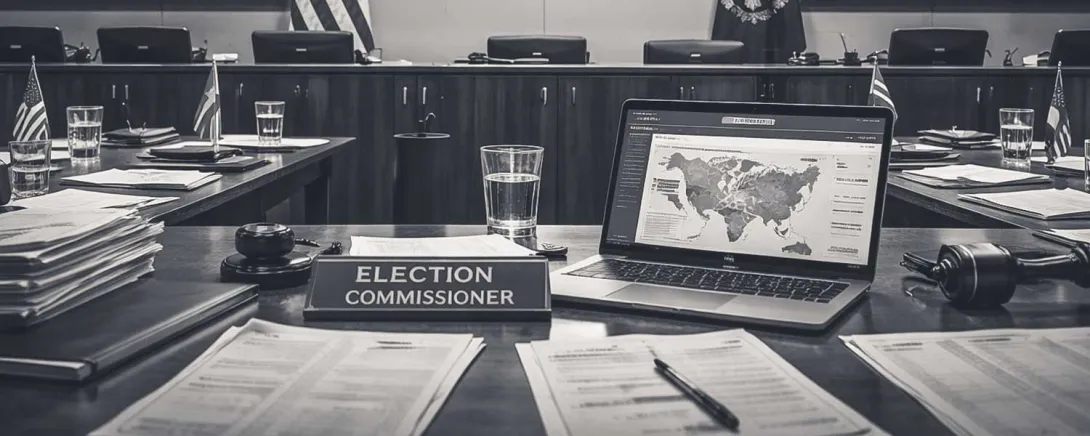
Elections are the foundation of democracy. To function well, they require not just fair rules, but fair administration—someone neutral to enforce those rules. Around the world, most democracies have solved this problem by creating independent election commissions. The United States, however, has taken a different path, with consequences that experts say undermine public trust.
How Independent Election Commissions Work Globally
Most democracies rely on independent electoral commissions, also called Election Management Bodies (EMBs), to administer elections and enforce election laws. These agencies are structurally separate from the executive government and are designed to be nonpartisan and professional.
This model has become the norm worldwide. As countries in Latin America, sub-Saharan Africa, and South Asia democratized in recent decades, they recognized a key principle: elections need a neutral arbiter. Many of these commissions are even written into national constitutions to guarantee their independence and permanence.
The results speak for themselves. A 2022 global analysis found that countries with independent, well-resourced election commissions experience:
- Lower levels of electoral violence
- Fewer public doubts about election legitimacy
- Greater acceptance of election results
In other words, when people trust the institution running the election, they're more likely to accept the outcome—even if their candidate loses.
Examples of Successful International Models
Several democracies with historically high voter trust demonstrate this principle:
- Canada: Elections Canada is a nonpartisan agency that handles voter registration, districting, and election administration. Canadians consistently report high confidence in the fairness of their elections.
- United Kingdom: The Electoral Commission is an independent body tasked with regulating campaign finance and ensuring electoral integrity.
- Australia, South Korea, and South Africa: Each has an independent electoral authority that manages everything from voter education to campaign finance oversight, with a clear mandate to remain politically neutral.
Research by the Electoral Integrity Project confirms the pattern. It shows established democracies with independent electoral authorities consistently score higher on electoral integrity indices than those where ruling parties control election administration.
The U.S. Approach: Fragmented and Partisan
The United States stands out as an outlier. Unlike most democracies, the U.S. does not have a single independent body administering federal elections. Instead:
- States manage their own elections, each setting their own rules and procedures.
- Campaign finance oversight falls to the Federal Election Commission (FEC)—the closest thing the U.S. has to a national election body.
However, the FEC itself has serious structural problems.
The Federal Election Commission's Dysfunction
The FEC is a six-member commission evenly split between Democrats and Republicans. On paper, this sounds balanced. In practice, it creates gridlock.
How It Works (and Doesn't):
When the FEC votes on enforcement actions, a 3-3 party-line split is common. Because a tie means no action is taken, this structure effectively allows partisan commissioners to block investigations into alleged campaign finance violations. Many violations go unpunished as a result.
Scholars and watchdog groups have been blunt in their assessments:
- The Campaign Legal Center's 2022 report warned that the FEC has gone from "dysfunctional to destructive," as partisan gridlock has shut down meaningful oversight of money in politics.
- Even former FEC commissioners have called the agency "toothless" and called for structural reforms.
- Commissioners often invoke "prosecutorial discretion" to block investigations, and until recently, courts had limited ability to review these non-decisions.
The Result: Unlike independent election commissions abroad, the FEC's credibility is undermined by its partisan design. It fails to act as a neutral referee between the parties.
The Fragmentation Problem
Because the U.S. lacks a centralized independent body, election oversight is fragmented across 50 states. This creates vulnerabilities:
- State election officials are sometimes openly partisan. Secretaries of state—who oversee elections in their states—are often elected on party tickets, raising questions about whether they can fairly "referee their own elections."
- Inconsistent standards. Different states have different rules for voter registration, polling place management, and ballot procedures, which can create confusion and disputes.
- Partisan controversies. Accusations that state officials favor their own party's candidates would likely be mitigated under an independent commission model.
Research suggests that this fragmented approach contributes to weaker enforcement of election laws and can erode public trust, especially in an era of deep political polarization.
What Reform Might Look Like
Experts have proposed several approaches to bring the U.S. more in line with international best practices:
- Restructure the FEC: Reduce the number of commissioners (to eliminate permanent ties) or give an impartial civil servant the tie-breaking vote.
- Create a new independent body: Replace the FEC entirely with a truly nonpartisan election management agency modeled on international examples.
- Strengthen state commissions: Encourage states to establish independent election commissions insulated from partisan control.
Several academic institutions and watchdog groups, including the Brennan Center for Justice and scholars at Harvard Law School, have detailed proposals for reform.
Why This Matters for Democracy
The difference between partisan and independent election administration may seem technical, but it has real consequences:
- Public Trust: When elections are run by trusted, nonpartisan institutions, there tend to be fewer complaints of fraud and greater acceptance of results.
- Enforcement: Independent commissions are more likely to investigate and punish violations fairly, regardless of which party is involved.
- Legitimacy: Even the appearance of fairness matters. When voters see a neutral institution in charge, they're more likely to believe the system is fair.
The United States has a choice. Most established democracies have concluded that independent, nonpartisan election commissions are essential to free and fair elections. The U.S. remains an outlier in this regard. As of 2024, experts continue to argue that adopting best practices from abroad—specifically, an empowered, genuinely independent election commission—could strengthen both the effectiveness and public perception of American elections.