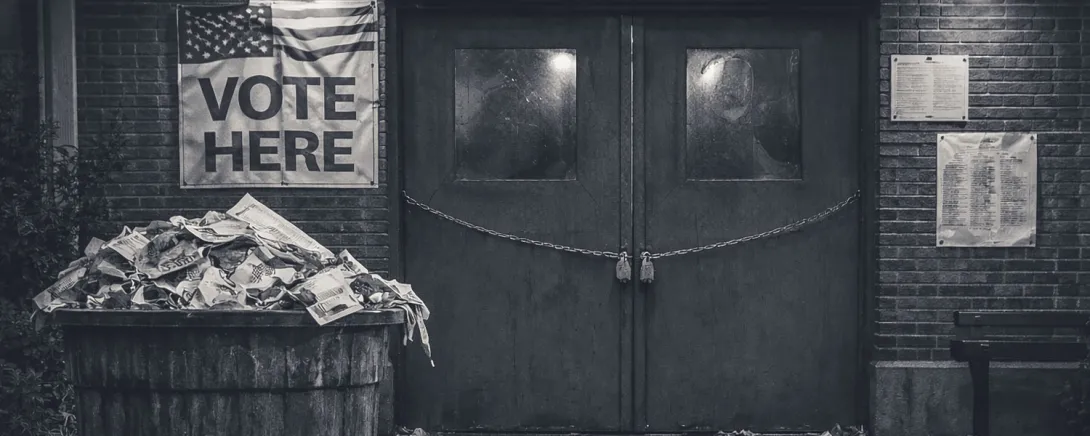
Voting is one of the most important rights in a democracy. In the United States, every eligible citizen should be able to cast their ballot freely and fairly. However, certain practices have made it harder for some Americans to vote. These practices are called "voter suppression," and understanding them is important for anyone who cares about how our democracy works.
What is voter suppression?
Voter suppression happens when rules, laws, or practices make it more difficult for people to vote. Sometimes these barriers affect everyone equally, but research shows they often have a bigger impact on certain groups, especially communities of color. While gerrymandering plays a big role in blocking fair access to voting, that is a topic that deserves its own feature. Instead, we will focus on three main tactics that research and civil rights organizations have raised concerns about: voter roll purges, polling place closures, and strict voter ID laws.
Voter roll purges
States maintain lists of registered voters called "voter rolls." Election officials regularly clean up these lists by removing people who have moved, passed away, or are no longer eligible to vote. This process is called "purging."
However, recent data shows that purges have increased dramatically. Between 2020 and 2022, over 19 million voter registrations were removed nationwide, a 21% increase compared to previous years. To put that in perspective, from 2016 to 2018 alone, more than 17 million voters were purged from the rolls.
The problem is that these purges can contain mistakes. Studies have found that eligible voters sometimes get their names removed by accident. When this happens, people show up at their polling place on Election Day only to discover they can't vote because their registration has disappeared.
This problem appears especially common in certain states. After the Supreme Court ruled in Shelby County v. Holder (2013), states that used to be watched by the federal government removed 40% more voters from their lists than other states. This suggests that without federal oversight, some areas remove voters from the rolls more aggressively.
Polling place closures
Another issue is the closing of polling places, the physical locations where people go to vote. Between 2012 and 2018, research documented 1,688 polling places that closed in areas previously monitored under the Voting Rights Act. This number was almost double what an earlier 2016 study had found.
When polling places close, voters must travel farther to cast their ballots and often face much longer lines. Studies prove this reduces how many people actually vote.
In April 2020, Milwaukee closed all but 5 of its 182 polling sites for a primary election. Black voter turnout fell by about 10 points.
One clear example comes from Milwaukee, Wisconsin. In April 2020, the city closed all but 5 of its 182 polling sites for a primary election. Researchers found this caused overall turnout to drop by more than 8 percentage points, with Black voter turnout falling about 10 points. Similarly, in Georgia, nonwhite voters faced hours-long waits because too few polling locations were available in their communities.
These closures don't affect everyone equally. Research shows they disproportionately impact communities of color, forcing residents in these areas to wait longer and travel farther just to exercise their right to vote.
Strict voter ID laws
Many states require voters to show identification before casting a ballot. Some states have "strict" photo ID laws, meaning voters must present specific types of government-issued photo identification.
Courts have examined these laws carefully. Federal judges in states like North Carolina and Texas struck down certain ID laws after finding they intentionally discriminated against Black and Latino voters. One judge wrote that North Carolina's law targeted African Americans "with almost surgical precision."
Academic research supports these concerns. One nationwide study found that strict ID laws reduced Hispanic voter turnout by 7.1 percentage points in general elections, Asian American turnout by about 5.4 points, and African American turnout by roughly 4.6 points in primaries. Meanwhile, white voter turnout remained unchanged or even increased slightly. This means ID requirements can widen the gap in voting rates between different racial groups.
Not all researchers agree on how large these effects are. One study in Florida and Michigan estimated strict ID laws might affect only 0.1-0.3% of voters. However, even this small percentage could change the outcome of very close elections.
Why it matters
The evidence is clear: these practices have measurable impacts. Purges remove millions from voter rolls, polling place closures significantly lower turnout in affected areas, and ID laws disproportionately reduce participation among communities of color.
In a democracy, every eligible voter deserves an equal opportunity to participate. Understanding voter suppression helps citizens recognize barriers to voting and encourages conversations about how to make elections more accessible for everyone. Whether you're just learning about elections or are already eligible to vote, knowing how these systems work is essential to protecting one of our most fundamental rights.